The General Trend of Port Automation
The demand for efficiency, safety and intelligence in the port logistics industry is increasingly urgent. The introduction of autonomous navigation technology for unmanned vehicles can not only improve operational efficiency but also effectively reduce safety accidents. Major ports are accelerating their automation transformation. At Yantai Port, with a 650,000-square-meter yard, AGV robots shuttle between the docks and multi-storey garages carrying finished vehicles. The independently developed intelligent guided vehicles (IGVs) based on navigation and positioning achieve efficient and precise positioning in complex port environments by integrating multiple technologies. All of these require high-performance LiDAR as the “eyes”.
Major Technical Challenges in Open-Air Operations
Open-air operating environments face three core technical challenges: GPS signal shadowing, frequent dynamic obstacles, and drastic changes in lighting conditions. These are specifically reflected in the following aspects:
Weather Interference:Rain and fog severely attenuate LiDAR signals, resulting in sparse point-cloud data. Changes in road surface reflectivity caused by rain and snow can reduce the ranging accuracy of LiDAR by more than 60%.
Strong Light Interference:Open-air port operations at noon are exposed to intense direct sunlight, with ambient light interference reaching tens of thousands of Lux. Conventional LiDARs may experience signal saturation and ranging failure under strong light.
Signal Blockage in Container Yards:In port scenarios, 40% of AGV malfunctions are caused by signal blockage from stacked containers.
Extreme Cold / High Temperature Environments:Winter temperatures at northern Chinese ports can drop below -30°C. Standard LiDARs face difficulties starting up and degraded detection performance in low-temperature conditions.
High-Precision Requirements for Heavy Loads:Port heavy-duty AGVs carry dozens of tons of containers, requiring parking position deviations within ±2 cm and travel path deviations within ±3 cm.
Our Solution
| Application Scenario | Recommended Product | Installation Method | Function |
| AGV Navigation | TM-LIDAR-16 | Roof / Front of the Vehicle | SLAM Mapping, Positioning & Navigation |
Application Effects
All-weather environmental perception: IP67K waterproof rating, wide operating temperature range and strong anti-interference capability ensure stable operation in extreme weather such as rain, extreme cold and high temperatures.360° blind-spot-free perception: 360° horizontal panoramic scanning with a 30° vertical field of view, providing unobstructed coverage of the AGV’s surroundings.Precise navigation and positioning: Combined with inertial navigation, it maintains high-precision positioning even in weak GPS signal areas such as container yards and under quay cranes.Efficient obstacle avoidance: Multi-echo technology improves adaptability to interferences such as rain, fog and dust. It identifies dynamic and static obstacles on the path in real time to ensure operational safety.24/7 uninterrupted automated port operation: The product has been deployed in large domestic ports, providing high-precision navigation and obstacle avoidance for AGVs.

Experts predict that by 2030, leading liquor enterprises will establish “lights-out factories” and achieve fully unmanned operations from raw material feeding to bottling.
Industry-level large-scale brewing models, through deep learning on the process data of tens of thousands of master brewers, will form a knowledge base of “digital master brewers”.
Intelligent brewing is rapidly shifting from an optional feature to a standard configuration.
Pain Points of the Fermentation Process in Traditional Distilleries
The process relies heavily on manual labor, resulting in prominent pain points. Feeding, discharging, and turning materials in fermentation pits of traditional distilleries are fully manual operations. This not only involves high labor intensity but also leads to low efficiency and unstable product quality.
High labor intensity and rising labor costs. In the past, it took at least 8 years to train a skilled distillation operator, with extremely heavy workloads. Labor shortages have become increasingly severe.
Poor process consistency and unstable quality. It is difficult to avoid the influence of environmental factors and individual differences. Highly dependent on manual experience, the same batch of raw materials may produce liquor of different quality under different teams, making it impossible to form standardized and reproducible production processes.
The fermentation environment poses risks to personnel health. Fermentation workshops maintain high temperature and humidity year-round, with the risk of harmful gas accumulation such as carbon dioxide and hydrogen sulfide. Long-term operation poses potential threats to workers’ health.
Our Solution
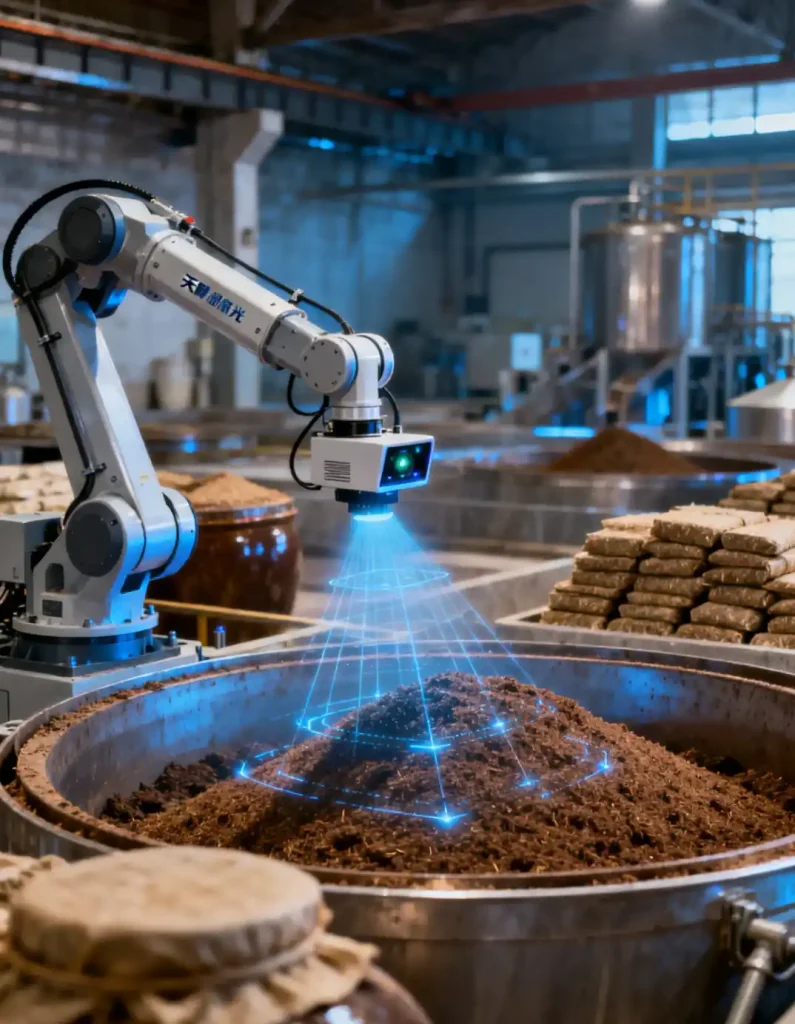
Overall Solution Architecture: A LiDAR from Tianmou Optoelectronics is mounted on the robotic arm to perceive the material distribution inside the fermentation tank in real time, guiding the robotic arm to accurately perform fermentation processes including feeding, discharging and material turning.
3D Point Cloud Data Acquisition: Based on the pulsed laser detection principle, the LiDAR accurately calculates the Time of Flight (TOF), enabling high-precision 3D modeling and data collection of the surrounding environment. It captures key parameters in real time, including the spatial position, height distribution and volume variation of materials inside the fermentation tank. These data are then converted into control signals recognizable by the robotic arm, empowering the equipment to perform operations with high precision.
Accurate Perception of 3D Material Morphology: Independent of ambient light, the LiDAR generates high-density 3D point cloud data to accurately reconstruct the surface morphology of material piles. It precisely identifies the height fluctuations, stacking status and boundary positions of materials, providing millimeter-level operational decision-making support for the robotic arm.
Precise Guidance for Robotic Arms: After algorithm processing of the 3D point cloud data obtained by LiDAR, the optimal grasping points, placement positions and motion trajectories of materials are calculated in real time, guiding the robotic arm to perform accurate feeding and discharging. Compared with traditional robotic arms that rely on fixed-point teaching, LiDAR-guided robotic arms can adapt to changes in material conditions and achieve truly intelligent and flexible operation.
Core Challenges of Grain Depot Management
Low efficiency of manual measurement:Traditional methods rely on manual operations with time-consuming processes. Restricted by granary space and irregular grain pile shapes, measurement results vary from person to person without unified standards.
Large measurement errors:Manual measurement is highly affected by operator experience and visual judgment. Hard-to-reach areas such as the top of grain piles lead to deviations between calculated data and actual conditions, further interfering with warehouse allocation, purchasing and sales decisions.
High safety risks:Grain depots are typical confined working spaces, accompanied by potential hazards such as dust pollution.
Solution Overview
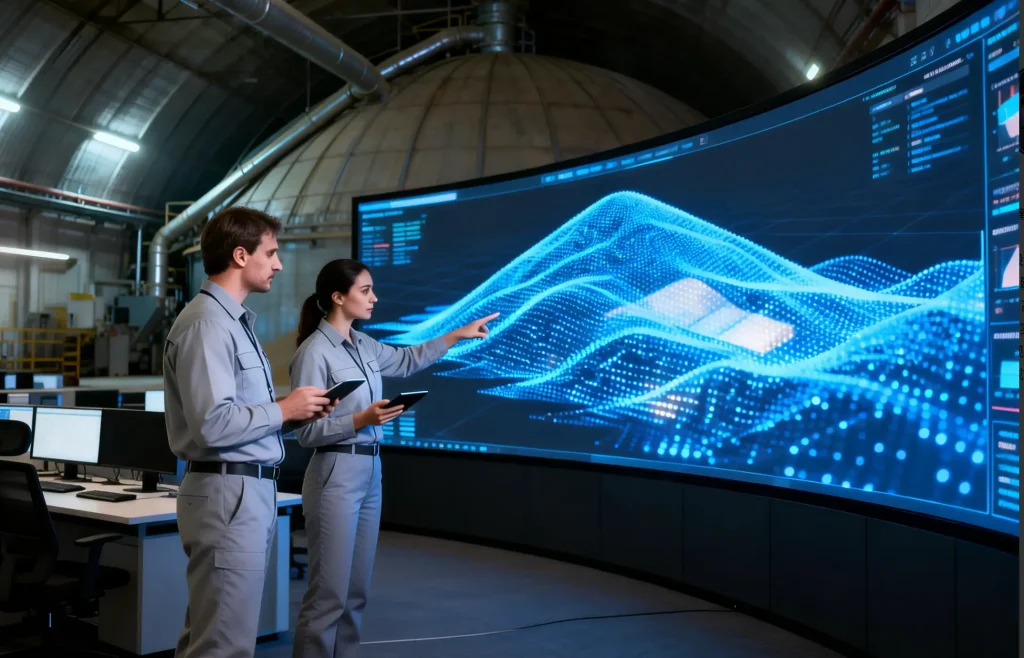
Developed specifically for confined-space storage scenarios such as grain depots, the 3D scanning and reconstruction LiDAR system.Optoelectronics deploys LiDAR devices at key positions inside granaries. It enables 360° rotating scanning of grain piles to collect high-precision 3D point cloud data and build real-time 3D digital models of grain depots.
The system fundamentally eliminates safety risks caused by manual in-granary operations, and provides visualized, data-driven intelligent management solutions for accurate grain inventory measurement and dynamic grain surface monitoring.
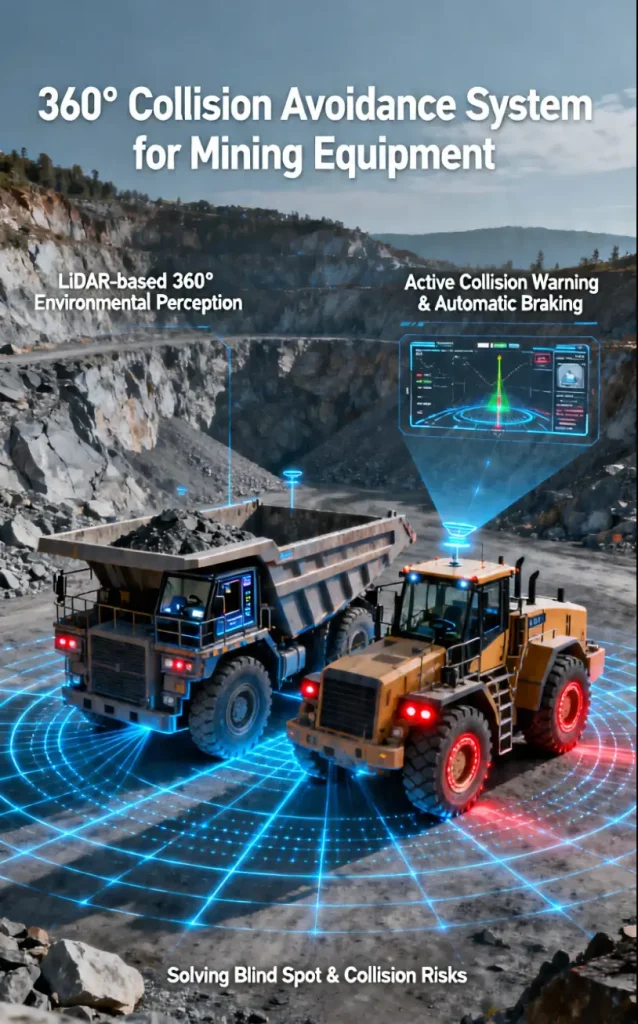
Solution Overview: Targeting the visual blind spots and collision risks of large mining equipment such as haul trucks and loaders, this system achieves 360° environmental perception through LiDAR, providing active anti-collision warning and automatic braking functions.
| Installation Position | Product Model | Detection Range | Functions |
| Front of Vehicle | Intrinsically Safe Explosion-Proof LiDAR | 150m forward | Forward anti-collision, AEB triggering |
| Rear / Sides of Vehicle | TM-16 | 360° × 150m | Blind spot monitoring, lane change assistance |
| Roof of Vehicle | TM128 Hybrid Solid-State LiDAR | 200m | Panoramic environmental perception |
Technical Highlights
Long-Distance Signal Transmission: Supports extension cables up to 15 meters with zero signal loss.
Intrinsically Safe & Explosion-Proof Certification: Tianmu Optoelectronics’ intrinsically safe LiDAR requires no additional flameproof enclosure, eliminating laser penetration loss. It features a compact form factor and excellent heat dissipation, and has obtained KA/MA certifications.
High Glare Resistance: Ensures stable operation under intense sunlight in Australia.
Extreme Environment Adaptability: Customized models support operation at -45℃, meeting the requirements of mining operations in high-altitude and cold regions.